Kernel Callbacks — How EDRs See Every Process, Thread, and Image
Kernel callback notes (WinDbg)
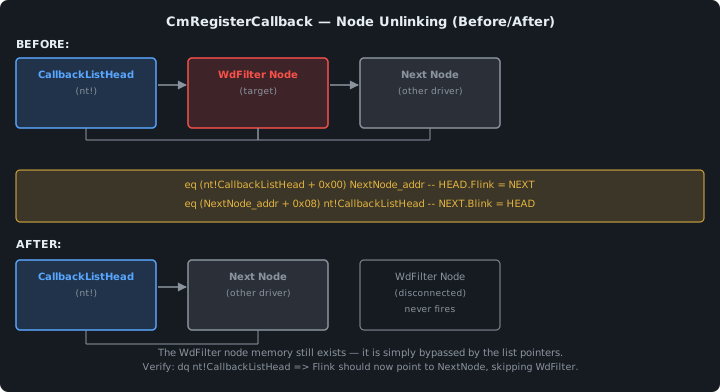
Drivers register for system events. Defender (WdFilter.sys) typically uses all five.
| API | Array / list | Event |
|---|---|---|
PsSetCreateProcessNotifyRoutineEx |
PspCreateProcessNotifyRoutine |
process create/exit |
PsSetCreateThreadNotifyRoutineEx |
PspCreateThreadNotifyRoutine |
thread create/exit |
PsSetLoadImageNotifyRoutineEx |
PspLoadImageNotifyRoutine |
EXE/DLL map |
ObRegisterCallbacks |
_OBJECT_TYPE.CallbackList |
handle open on Process/Thread |
CmRegisterCallbackEx |
CallbackListHead |
registry |
.reload /f first if names do not resolve. LiveKD is read-only — ep / eb / eq need a writable kernel debug session.
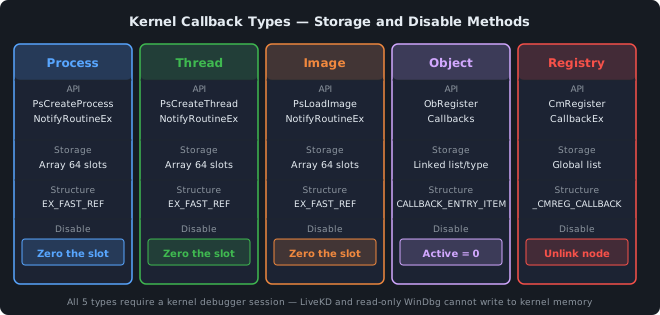
EX_FAST_REF (notify arrays only): slot is pointer + refcount in the low 4 bits.
block    = slot & 0xFFFFFFFFFFFFFFF0
function = *(block + 0x08)
Same block for process, thread, and image notify:
_EX_CALLBACK_ROUTINE_BLOCK
+0x000  RundownProtect    sync (0x20 = active)
+0x008  Function          callback pointer  ← lm a this
+0x010  Context           value from registration
1. Process / thread / image notify
64-slot arrays. Same steps; only the symbol changes.
Dump
dp nt!PspCreateProcessNotifyRoutine
dp nt!PspCreateThreadNotifyRoutine
dp nt!PspLoadImageNotifyRoutine
dp = dump pointers. Non-zero = used slot. Zeros = empty. Save array base (left column of the first line). Slot i is at base + i*8.
Decode one slot
dq (<raw_slot> & 0xfffffffffffffff0)
Mask low nibble → _EX_CALLBACK_ROUTINE_BLOCK. +0x08 = function.
Owner
lm a <function>
Which driver contains that address.
RVA (for tools)
? nt!PspCreateProcessNotifyRoutine - nt
? nt!PspCreateThreadNotifyRoutine  - nt
? nt!PspLoadImageNotifyRoutine     - nt
KASLR moves the base; RVA stays for that build.
Zero a slot
ep <array_base + index*8> 0
Kernel skips NULL slots.
All used slots (first 14)
.for (r $t0 = 0; @$t0 < 14; r $t0 = @$t0 + 1) { r $t1 = poi(nt!PspCreateProcessNotifyRoutine + (@$t0 * 8)); .if (@$t1 != 0) { r $t2 = poi((@$t1 & 0xfffffffffffffff0) + 8); .printf "Slot %d: fn=%p\n", @$t0, @$t2; lm a @$t2 } }
Swap the symbol for thread/image.
2. ObRegisterCallbacks (handles)
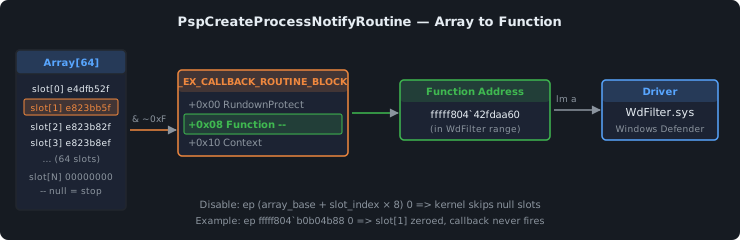
Linked list on Process (index 7) and Thread (index 8). Disable via Active, do not unlink.
_OBJECT_TYPE
+0x0C8  CallbackList      LIST_ENTRY head

CALLBACK_ENTRY_ITEM
+0x000  Flink / Blink
+0x010  Operations        1=create, 2=dup, 3=both
+0x014  Active            1=on, 0=off  ← eb this
+0x028  PreOperation      callback  ← lm a this
+0x030  PostOperation     or NULL
Empty list: Flink == type_addr + 0xC8.
Type objects
dp nt!ObTypeIndexTable
[7] Process, [8] Thread.
List empty?
dt nt!_OBJECT_TYPE <type_addr>
Look at +0xC8 CallbackList. Flink ≠ head → first node is that Flink.
Dump node
dq <node> L7
lm a <PreOperation>
Disable
eb (<node> + 0x14) 0
Kernel checks Active before PreOperation. Walk Flink until it equals type_addr + 0xC8.
3. Registry (CmRegisterCallbackEx)
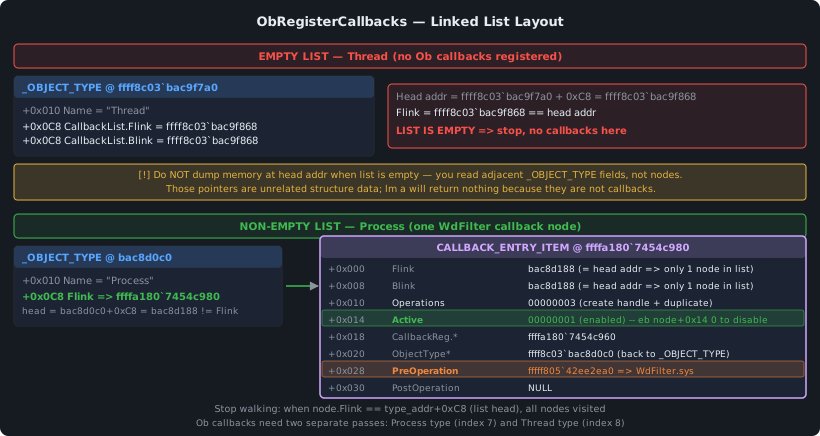
List at CallbackListHead. No Active field — unlink the node.
_CMREG_CALLBACK
+0x000  Flink
+0x008  Blink
+0x028  Function          callback  ← lm a this
+0x028 is hex = 40 decimal. Each pointer is 8 bytes, so QWORD index = 40 / 8 = 5 (0-based; the 6th QWORD, bytes 40–47). Not decimal 28.
Empty: Flink == CallbackListHead.
Head
dq nt!CallbackListHead
Node + owner
dq <node>
lm a <function>
Unlink
eq <PREV>            <NEXT>
eq (<NEXT> + 0x08)   <PREV>
Walk Flink until it equals the head.
Commands
| Cmd | Does |
|---|---|
dp / dq |
dump pointers / QWORDs |
ep / eb / eq |
edit pointer / byte / QWORD |
dt |
dump typed struct |
lm a |
module containing address |
poi(addr) |
read pointer at addr |
Offsets (+0xC8, +0x28, …) are build-specific — confirm with dt on the target.